Breast cancer is the most common cancer among women.
The good news? When it’s found early, it’s very treatable. That’s why regular breast screening is so important.
Screening uses a special X-ray called a mammogram to look for early signs of breast cancer. It can pick up tiny changes in the breast, sometimes years before you or your doctor can feel anything.
Finding cancer early means:
- Simpler treatments
- Better chance of full recovery
- Less need for major surgery
Screening saves lives by helping doctors detect breast cancer early — often when it’s still confined and easier to treat.
The Earliest Form of Breast Cancer: DCIS
One of the earliest forms of breast cancer that can be found through screening is called Ductal Carcinoma in Situ (DCIS).
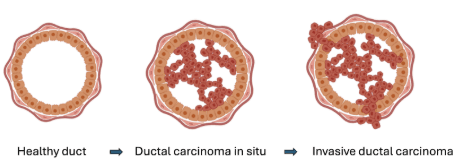
(Illustration: Healthy duct → DCIS → Invasive ductal carcinoma)
DCIS is an early stage of breast cancer where abnormal cells stay inside the milk duct. They haven’t broken through the duct wall into nearby breast tissue. Because the cells are still “in place,” this type of cancer is called in situ (Latin for “in its place”)..
DCIS is not life-threatening, but it can turn invasive over time if left untreated.
That’s why regular screening and early treatment make such a big difference. When detected early through a mammogram, treatment is highly effective and the outlook is excellen
How Doctors Plan Your Treatment
Once DCIS is diagnosed, your doctors will meet as a team to plan your care.
This is called a multidisciplinary team meeting (MDT) where specialists come together to find the best treatment approach for you.
The team usually includes:
- A breast surgeon (the doctor who performs your surgery)
- A cancer specialist (oncologist)
- A radiologist (who reads your scans)
- A pathologist (who studies your tissue samples)
- A breast care nurse or counsellor (to support you through treatment)
They’ll look at:
- How big the DCIS is and whether it’s in one or more areas
- The grade — how abnormal or “active” the cells look
- Whether your DCIS has hormone receptors (which helps guide treatment)
- Your overall health and personal preferences
DCIS Grades — What It Means
The grade of DCIS tells doctors how different the cells look compared to normal breast cells, and how quickly they may grow.
- Low-grade: Cells look quite normal and grow slowly.
- Intermediate-grade: Cells look slightly more abnormal and grow a bit faster.
- High-grade: Cells look very different and grow more quickly. This type has a higher chance of returning or becoming invasive if not treated.
Knowing the grade helps your doctor choose the most suitable treatment plan.
Higher-grade DCIS may need stronger treatment or closer follow-up.
What Is “Microinvasion”?
Sometimes, after surgery, the pathologist may find that a few cells have just started to move through the wall of the duct. This is called DCIS with microinvasion.
It’s still considered very early stage, but your doctor may check nearby lymph nodes to be safe.
Treatment is still highly effective, and recovery rates are excellent.
How DCIS Is Treated
The good news: DCIS is very treatable, and most women recover fully.
Here’s how it’s usually managed:
1. Surgery
The main treatment is surgery to remove the DCIS.
- Breast-conserving surgery (lumpectomy): Only the part of the breast with DCIS is removed; most of the breast is kept.
- Mastectomy: If DCIS is widespread or in several areas, the whole breast may need to be removed. Breast reconstruction can often be done at the same time or later, if you wish.
2. Radiotherapy
If you have breast-conserving surgery, you may also need radiotherapy to the breast.
This reduces the chance of DCIS coming back.
3. Hormone (Endocrine) Therapy
If your DCIS is sensitive to hormones (called oestrogen receptor-positive), your doctor may recommend tablets such as tamoxifen or aromatase inhibitors.
These help lower the risk of new breast changes in the future.
4. Follow-Up Care
After treatment, you’ll have regular check-ups and mammograms to make sure everything stays healthy.
A healthy lifestyle, eating well, exercising, maintaining a healthy weight, and limiting alcohol and smoking can also help protect your breasts.
In Summary
- Breast screening helps detect cancer early, before symptoms appear.
- DCIS is an early, non-invasive form of breast cancer found inside the milk ducts.
- Treatment is highly effective — often surgery, sometimes followed by radiotherapy or hormone tablets.
- With early detection, most women make a full recovery and continue to live healthy, active lives.
What’s Next?
Every woman's experience with DCIS is different.
The right treatment depends on the size, grade, and type of DCIS — as well as your personal preferences and overall health.
In our next post, we’ll explore the different treatment options in more detail, including what to expect before and after surgery, how radiotherapy and hormone therapy fit in, and how follow-up care supports long-term recovery.
Stay tuned as we take a closer look at treatment considerations for DCIS, and how each choice is tailored to you.